
Remote Sensing is the process of collecting and analyzing information about objects or areas on Earth’s surface without being in direct contact with them. It typically involves the use of sensors mounted on satellites, aircraft, drones, or ground-based platforms to detect and measure radiation reflected or emitted from the surface.
1, Advantages of Remote Sensing for Oil Spill Detection
-Wide Coverage: Monitors vast areas, including remote or inaccessible locations.
-Real-Time Monitoring: Provides immediate data for rapid response.
-All-Weather Capability: Radar-based systems work in adverse weather and low-light conditions.
-Non-Invasive: No physical contact with the spill is required.
2, Techniques Used in Remote Sensing
A. Optical Sensors
Visible Light Sensors: Capture images showing oil slicks in contrast to water.
Useful for small-scale or thin-layer spills in clear conditions.
Infrared (IR) Sensors: Detect temperature differences between oil and water.
Effective at night or under cloudy conditions.
B. Radar (Microwave) Sensors
Synthetic Aperture Radar (SAR): Detects changes in water surface roughness caused by oil slicks, appearing as smooth patches.
Works in all weather conditions, day or night.
Ideal for large-scale marine spill detection.
C. Ultraviolet (UV) Sensors

Detect the fluorescence of oil under UV light, highlighting the oil’s presence.
Useful for identifying thin oil layers or tracking spills during initial stages.
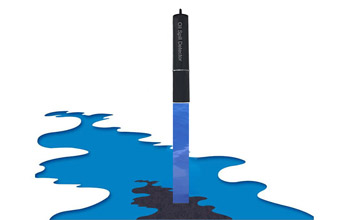
UV Fluorescence Non-contact Oil Spill Detection Sensor
D. Thermal Imaging
Measures temperature variations between oil and water.
It is particularly effective when oil is significantly warmer or cooler than the surrounding water.
E. Multispectral and Hyperspectral Imaging
Multispectral Sensors: Capture data in multiple wavelengths, identifying oil’s distinct spectral signature.
Hyperspectral Sensors: Provide more detailed spectral data for differentiating oil types and thickness.
F. Satellite Remote Sensing
Satellites like Sentinel-1, Landsat, and MODIS have sensors to monitor large areas.
Useful for tracking oil spill spread over time.
Enables historical data analysis to identify spill patterns.
3, Key Components of Remote Sensing
A, Sensors:
Passive Sensors: Detect natural energy, such as sunlight reflected by the Earth’s surface (e.g., optical and infrared sensors).
Active Sensors: Emit their energy (e.g., radar or LiDAR) and measure the reflected signal.
B, Platforms:
Satellite-Based: Offer global coverage and consistent data over time.
Airborne (e.g., drones, planes): Provide high-resolution images for localized studies.
Ground-Based: Complement aerial and satellite data for calibration or detailed measurements.
C, Electromagnetic Spectrum:
Remote sensing uses various parts of the electromagnetic spectrum, including visible light, infrared, microwave, and ultraviolet, to gather data.
D, Data Processing and Analysis:
Collected data are processed using software to extract useful information, such as mapping, classification, and change detection.
The latest non-contact oil spill detection sensor developed by OPS adopts ultraviolet UV remote sensing technology, which is more cost-effective than the detectors already on the market. Please leave a message to get a quote.
Tags: Remote Sensing, Oil Spill Detection, Ultraviolet (UV) Oil Spill Sensors, Suppliers, manufacturers, factory, wholesale, buy, price, quotation, bulk, for sale, companies, stock, cost.
Related Products:
UV Fluorescence Non-contact Oil Spill Detection Sensor
Related Blogs:
Three types of oil sensors: Oil in Water Sensor, PAH Sensor, and Oil Spill Detector Sensor
Oil Leaks or Spills Detecting Methods and Sensors
To send An Enquiry Now: