
The emission monitoring system in an Exhaust Gas Cleaning System (EGCS) is critical for ensuring that emissions are within environmental regulations and for optimizing the system’s performance. Here are the main components and functions of the emission monitoring system in an EGCS:
Main Components of Emission Monitoring System
Sampling Probes:
Function: Installed in the exhaust gas stream to collect representative samples of the exhaust gas for analysis.
Location: Typically placed at the outlet of the scrubber or near the exhaust stack.
Pre-treatment Unit:
Function: Conditions the sample before it reaches the analyzers. This may include removing particulates, cooling the gas, and removing moisture.
Components: Filters, condensers, and dryers.
Gas Analyzers:
Function: Measure the concentration of various gases and pollutants in the exhaust gas.
Types of Analyzers:
SOx Analyzers: Measure sulfur oxides (SOx) concentrations.
NOx Analyzers: Measure nitrogen oxides (NOx) concentrations.
CO2 Analyzers: Measure carbon dioxide (CO2) concentrations.
O2 Analyzers: Measure oxygen (O2) levels to help in combustion efficiency assessment.
PAH Analyzers: Measure polycyclic aromatic hydrocarbons (PAHs) concentrations.
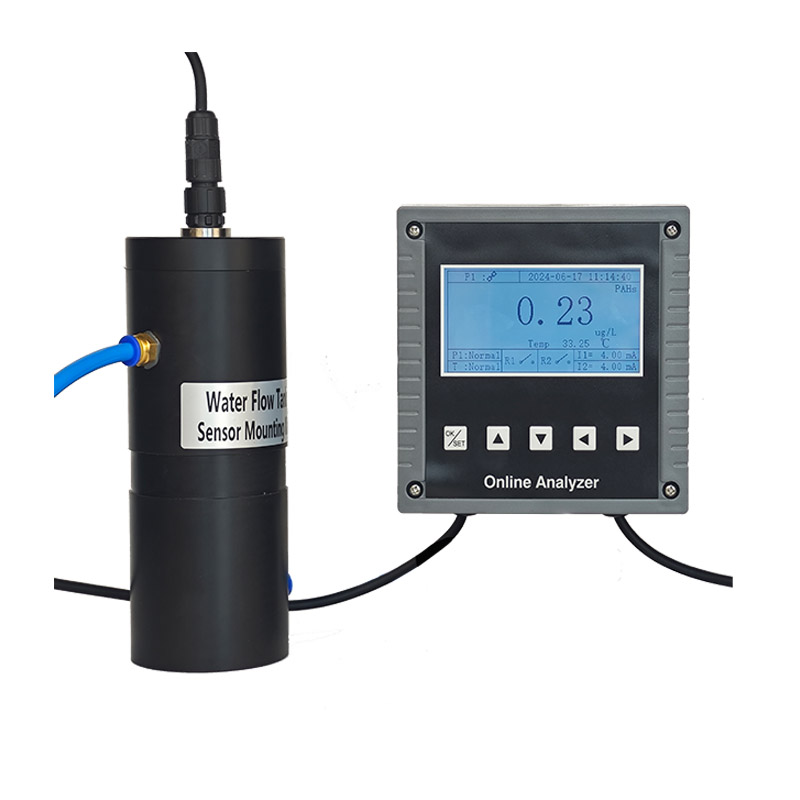
We OPS developed PAH sensors to measure PAH concentration in 2023, it can detect and measure polycyclic aromatic hydrocarbons (PAHs) from 0 to 1000 ppb (µg/L). OPS PAH Sensor operates on the principle of UV fluorescence, which is much more sensitive than the conventionally used infrared scattering or absorption method. Know more about our PAH sensor, Please email sale@dshech.com.
Particulate Matter (PM) Monitors:
Function: Measure the concentration of particulate matter in the exhaust gas.
Technology: Often uses laser-based methods for real-time monitoring.
Flow Meters:
Function: Measure the flow rate of the exhaust gas to ensure that the sampling is representative and to calculate total emissions.
Types: Can include mass flow meters and volumetric flow meters.
Data Acquisition and Control System:
Function: Collects data from all the analyzers and sensors, processes the data, and controls the emission monitoring system.
Components: Includes data loggers, controllers, and software for data analysis and reporting.
Calibration System:
Function: Ensures the accuracy and reliability of the gas analyzers and sensors.
Components: Standard gas cylinders and automatic calibration routines.
Functions and Importance of Emission Monitoring System
Real-Time Monitoring:
Provides continuous, real-time data on the concentration of pollutants in the exhaust gas.
Enables operators to make immediate adjustments to the EGCS to ensure optimal performance.
Compliance with Environmental Regulations:
Ensures that the ship or industrial facility complies with international and local emission standards (e.g., IMO regulations for ships).
Helps avoid fines and penalties associated with non-compliance.
Performance Optimization:
By monitoring emissions, operators can optimize the operation of the EGCS, improving its efficiency and reducing operational costs.
Identifies trends and potential issues before they become serious problems.
Data Logging and Reporting:
Continuous logging of emission data helps in creating detailed reports for regulatory bodies.
Provides historical data that can be used for performance analysis and maintenance planning.
Alarm and Safety Systems:
The emission monitoring system can trigger alarms if pollutant levels exceed preset limits, allowing for immediate corrective action.
Enhances the overall safety of the operation by ensuring that harmful emissions are kept under control.
Maintenance and Calibration
Regular Calibration: Periodic calibration of the gas analyzers and sensors using known standard gases to maintain measurement accuracy.
Maintenance: Routine checks and maintenance of sampling probes, filters, and other components to ensure they are clean and functioning correctly.
Software Updates: Keeping the data acquisition and control software up-to-date to ensure compatibility with regulatory requirements and technological advancements.
In summary, the emission monitoring system is a vital component of the EGCS, providing the necessary tools for real-time monitoring, compliance, performance optimization, and safety.
Tags: Emission Monitoring System, EGCS, PAH Analyzers, Measure polycyclic aromatic hydrocarbons (PAHs) concentrations, detect and measure polycyclic aromatic hydrocarbons, Suppliers, manufacturers, factory, wholesale, buy, price, quotation, bulk, for sale, companies, stock, cost.
Related Products:
PAH Sensor for Oil in Water Measurement
Related Blogs:
Success Case of OPS PAH Sensors used for Exhaust Gas Cleaning System (EGCS)
Why do exhaust gas cleaning systems (EGCS) need a PAH measurement sensor?
Detecting and Measuring Polycyclic Aromatic Hydrocarbons (PAHs) with Fluorescence Sensors
Video:
To send An Enquiry Now: