
Water quality sensor technology has become essential for ensuring the aquaculture environment’s quality and improving production efficiency. As aquaculture becomes more large-scale and intensive, traditional manual monitoring methods can no longer meet efficiency and real-time water quality management demands. Water quality sensors, as the core tools for monitoring aquaculture environments, have made significant progress. The following outlines the current status and future trends of water quality sensors in aquaculture:
I. Current Status
Diverse Types of Sensors
Aquaculture water quality sensors mainly monitor key parameters such as dissolved oxygen, pH, temperature, ammonia nitrogen, nitrate, salinity, and turbidity. These sensors are categorized into different types:
Electrochemical sensors: Widely used for detecting dissolved oxygen, pH, and ammonia nitrogen.
Optical sensors: Primarily used to monitor turbidity, chlorophyll, and algae in the water.
Ion-selective electrode sensors: Used for detecting specific ions in the water, such as ammonia nitrogen and nitrate.
Biosensors: Employ biological materials to detect organic pollutants and toxic substances in the water.
Real-time Online Monitoring
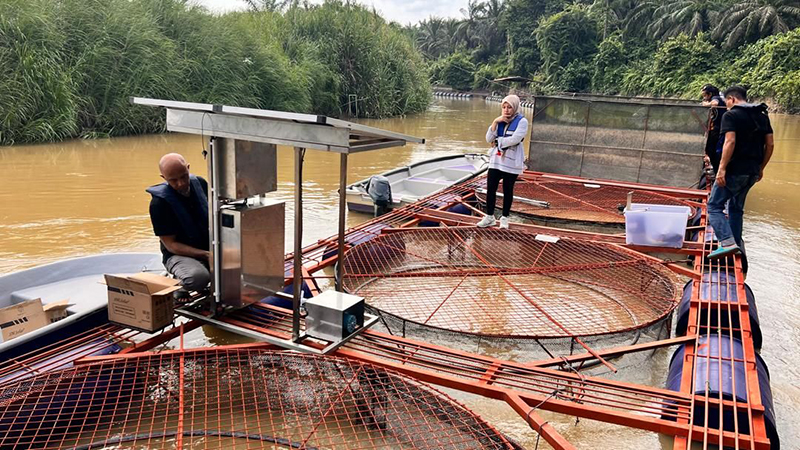
With the development of the Internet of Things (IoT), more and more water quality sensors are achieving real-time online monitoring capabilities. Through wireless transmission technologies such as Wi-Fi, LoRa, and NB-IoT, water quality sensor data can be transmitted in real-time to monitoring platforms, allowing aquaculture managers to view and analyze water quality conditions at any time.
Intelligence and Automation
Some high-end water quality monitoring systems are integrating intelligent analysis and automated control functions. Data collected by the sensors can not only be displayed in real time but can also be combined with smart algorithms to provide early warnings of abnormal water quality. These systems can even automatically control equipment like aerators and medication dispensers, enhancing the efficiency and precision of aquaculture management.
Cost Reduction and Popularization
Advances in sensor manufacturing technology and large-scale production have reduced costs, leading to the increasing application of water quality sensors in small- and medium-sized aquaculture operations. Portable and multifunctional sensors, in particular, are suitable for use in farms of various sizes.
II. Development Trends
Multi-parameter Integrated Sensors
Future water quality sensors will trend toward multi-parameter integration. Integrated sensors will be able to simultaneously detect multiple key water quality parameters, reducing the complexity of installation and maintenance while also lowering costs. These sensors have particularly strong market potential in intensive aquaculture environments.
Miniaturization and Portability
Sensor designs are moving toward miniaturization and portability. Smaller sensors can be easily deployed in various aquaculture environments, adapting to different scenarios. Portable sensor devices allow for quick, on-the-spot testing, especially in remote or distributed farming areas.
High Sensitivity and Low Power Consumption
Future sensor technology will further improve sensitivity and accuracy to better monitor low concentrations of pollutants and subtle environmental changes. Low-power designs will extend sensor operating times, making them particularly useful in remote or unattended aquaculture sites.
Integration with IoT and Big Data
As IoT technology progresses, water quality sensors will be deeply integrated with cloud computing and big data technologies. Data collected by sensors will be uploaded in real-time to the cloud for analysis. Through big data analysis, potential trends and risks in water quality changes can be identified. Combined with smart algorithms, future systems may achieve more precise water quality predictions and control.
Self-cleaning and Self-calibration Technologies
Long-term operation of water quality sensors can be affected by biofouling and sediment buildup, leading to decreased accuracy. To address this, future sensors may incorporate self-cleaning and self-calibration features, reducing the frequency of manual maintenance and ensuring reliability over extended use.
New Materials and Detection Technologies
The application of advanced nanomaterials, optical materials, and new sensing technologies (such as fiber optic sensing and surface plasmon resonance) will further enhance the detection capabilities and anti-interference performance of water quality sensors. These new materials and technologies could lead to higher sensitivity, a broader detection range, and lower costs.
III. Challenges
Sensor Stability and Durability
Aquaculture environments are complex and variable. Water quality sensors must maintain stability and durability during long-term use. In environments with high temperatures, low oxygen levels, and fluctuating salinity, sensors are prone to drift and damage.
Data Transmission and Security
In large-scale aquaculture operations, the connection between sensors and the cloud may face issues with unstable data transmission, particularly in areas with limited network coverage. Additionally, data security is an important concern to prevent water quality data from being attacked or tampered with during transmission and storage.
Economic Feasibility
Although the cost of water quality sensors has decreased, for some small-scale farms, the expense of configuring a full intelligent monitoring system can still be a financial burden. Therefore, balancing the cost and benefits of high-tech equipment remains an important issue to consider.
Conclusion
The current status of water quality sensors in aquaculture indicates that this technology is evolving toward diversification, intelligence, and integration. Future sensors will make greater advances in detection accuracy, application scenarios, and intelligent analysis. With the deep integration of IoT and big data, water quality monitoring will become increasingly smart and efficient. Despite some technical and economic challenges, the prospects for the application of water quality sensors in the aquaculture industry are promising.
Tags: water quality sensors in aquaculture, water quality sensors, Trends of Water Quality Sensors, Water quality sensors technology, cost of water quality sensors, Suppliers, manufacturers, factory, wholesale, buy, price, quotation, bulk, for sale, companies, stock, cost.
Related Products:
https://opticaldosensor.com/product-center
DS380 Fluorescent Dissolved Oxygen Sensor
DYS-1 Portable Handheld Dissolved Oxygen Meter
Related Blogs:
Top 13 Commonly Used Water Quality Sensors in Aquaculture
Optical Water Quality Sensor Technology: At the Forefront of the Water Quality Monitoring Industry
Optical Water Quality Sensors Have Attracted Much Attention in the Field of Aquaculture
To send An Enquiry Now: