
In today’s environmentally conscious world, monitoring oil in water is critical across various industries, from oil and gas to wastewater treatment. Oil in water analyzers are essential tools that provide real-time data to ensure regulatory compliance and environmental protection. However, these analyzers employ different detection methods, each with unique advantages and applications. Understanding these methods can help industries choose the most suitable technology for their specific needs. This article delves into the primary detection methods used in oil in water analyzers: fluorescence, infrared (IR) absorption, ultrasonic, and gravimetric.
Fluorescence Detection
How It Works:
Fluorescence detection involves exciting oil molecules in the water with ultraviolet (UV) light, causing them to emit light at a different wavelength. The analyzer measures this emitted light to determine the concentration of oil.
Advantages:
High Sensitivity: Fluorescence detection is highly sensitive, capable of detecting very low concentrations of oil.
Rapid Response: Provides real-time, continuous monitoring, making it ideal for immediate detection and response.
Non-Contact Measurement: Since it doesn’t require physical contact with the sample, it reduces the risk of contamination.
Applications:
Environmental Monitoring: Ideal for monitoring oil spills in natural water bodies.
Industrial Effluents: Used in industries to ensure wastewater discharge meets regulatory standards.
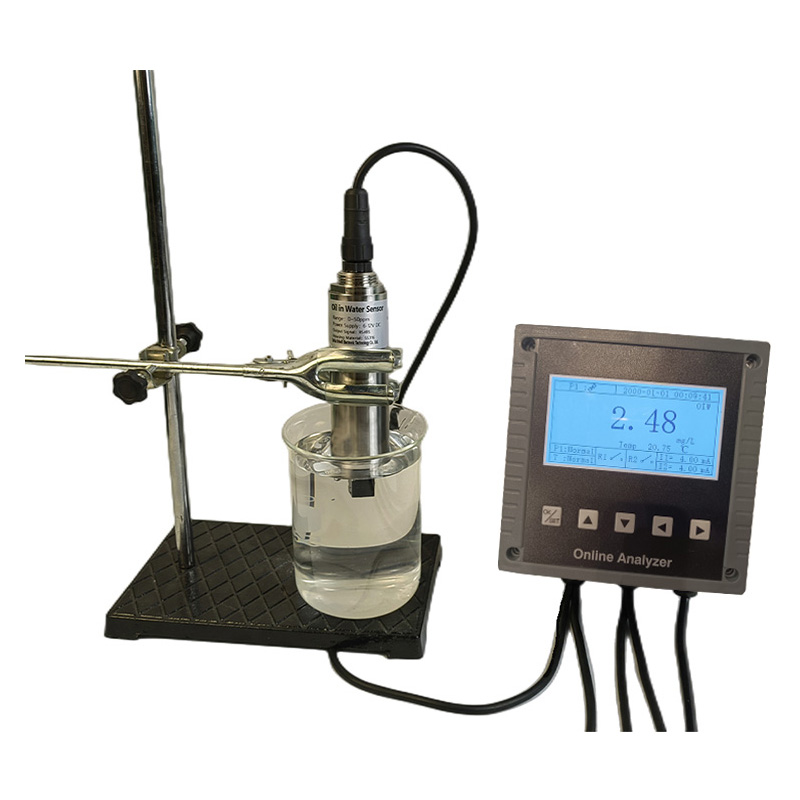
OPS DS530 Online Oil in Water Analyzer is a complete solution for oil in water measurements in the waste water. The oil in water sensor adopts the principle of ultraviolet fluorescence analysis, has high sensitivity, and can detect soluble and emulsifiable oils. In addition, the self-cleaning brush version can be selected to effectively eliminate the influence of oil pollution on the measurement. It is suitable for a variety of water quality measurement scenarios such as oilfield monitoring, industrial circulating water, condensate, wastewater treatment, and surface water stations.
Infrared (IR) Absorption
How It Works:
IR absorption detection measures the amount of infrared light absorbed by oil in the water. Different oil compounds absorb IR light at specific wavelengths, allowing the analyzer to quantify the oil concentration.
Advantages:
Specificity: Can differentiate between various types of oils based on their absorption spectra.
Non-Destructive Testing: The sample remains unchanged, allowing for further analysis if needed.
Robust Performance: Effective in a wide range of environmental conditions.
Applications:
Oil and Gas Industry: Monitoring produced water to ensure it is free from hydrocarbons before disposal or reuse.
Petrochemical Plants: Ensuring process water quality and compliance with environmental regulations.
Ultrasonic Detection
How It Works:
Ultrasonic detection uses sound waves to detect oil droplets in water. The presence of oil affects the speed and attenuation of the sound waves, allowing the analyzer to determine the oil concentration.
Advantages:
Durability: Ultrasonic sensors are robust and can withstand harsh industrial environments.
Low Maintenance: Requires minimal maintenance compared to other detection methods.
Versatility: Effective for detecting a wide range of oil types and concentrations.
Applications:
Wastewater Treatment: Monitoring and controlling oil levels in wastewater treatment processes.
Marine Industry: Ensuring bilge water discharge complies with environmental standards.
Gravimetric Detection
How It Works:
Gravimetric detection involves separating the oil from the water, typically by using a solvent. The oil is then weighed to determine its concentration in the water sample.
Advantages:
High Accuracy: Provides precise measurements of oil concentration.
Standard Method: Often used as a reference method for calibrating other analyzers.
Comprehensive Analysis: Can analyze total oil content, including dissolved and dispersed oils.
Applications:
Laboratory Testing: Used in laboratories for accurate analysis of water samples.
Calibration: Calibrating other types of oil in water analyzers to ensure their accuracy.
Choosing the Right Detection Method
Selecting the appropriate detection method depends on several factors, including the specific application, required sensitivity, environmental conditions, and maintenance capabilities. Fluorescence and IR absorption are excellent for high-sensitivity applications and real-time monitoring, while ultrasonic is preferred in harsh environments for its durability. Gravimetric detection, although more labor-intensive, provides high accuracy and is suitable for laboratory settings.
Understanding the different detection methods in oil in water analyzers is crucial for making informed decisions about monitoring and managing oil contamination. Each method offers distinct advantages, making them suitable for various industry applications. By choosing the right technology, businesses can ensure compliance with environmental regulations, protect natural water resources, and maintain efficient operational processes.
Tags: Oil in Water Analyzers, monitoring oil in water, Fluorescence Oil in Water Analyzers, oil in water measurements, Suppliers, manufacturers, factory, wholesale, buy, price, quotation, bulk, for sale, companies, stock, cost.
Related Products:
DS530 Online Oil In Water Sensor 0-200ppm
PAH Sensor for Marine Scrubbers Wash Water Monitoring System
Related Blogs:
What to Look for When Buying Oil in Water Sensors
How Oil in Water Sensors Work and Tips for Operation?
10 sets oil in water sensors and controllers will be sent to Russia
Video:
To send An Enquiry Now: